Do I Need a Scaffolding Licence or Permit?
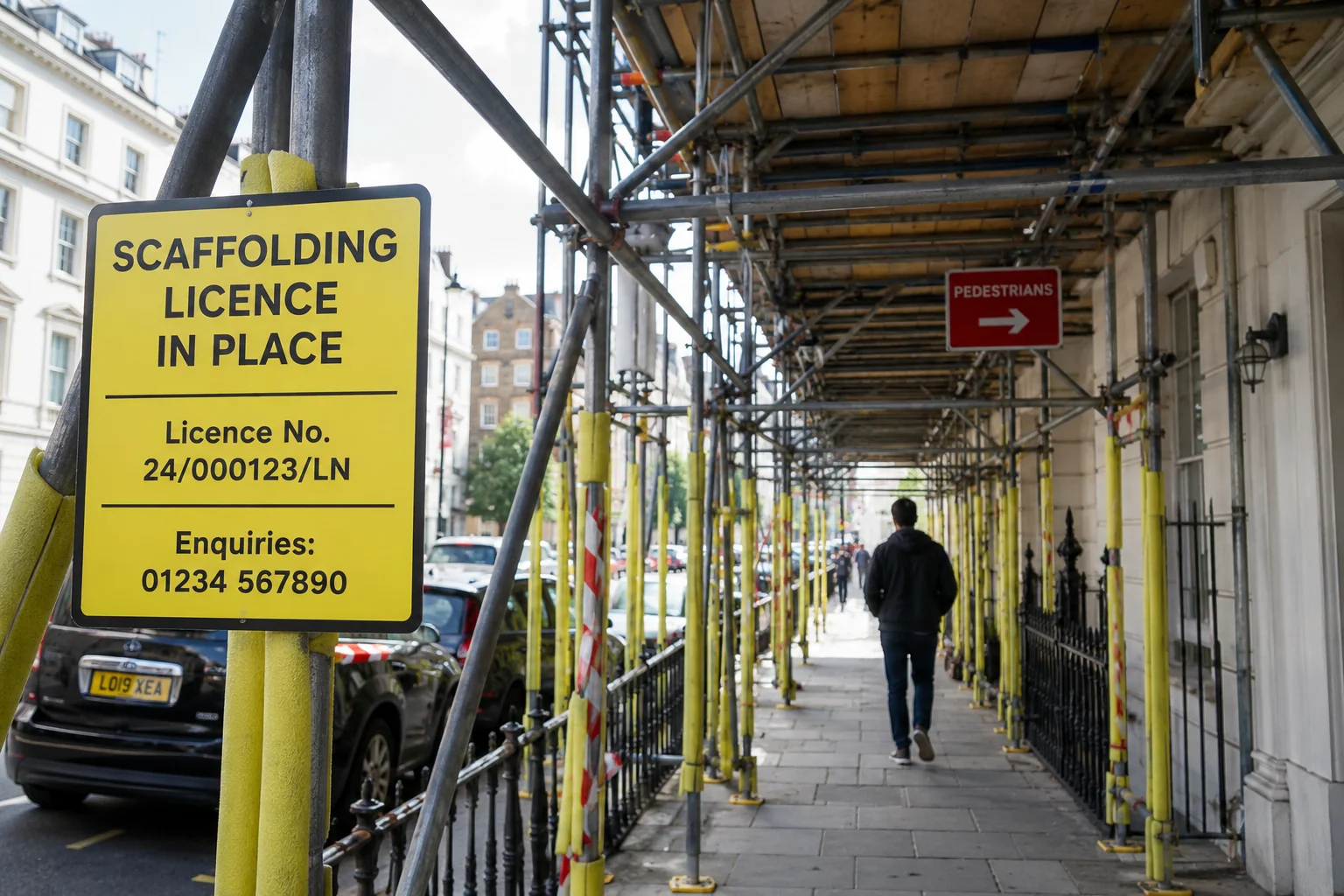
A scaffold licence is not required simply because scaffolding is being erected. The important question is where the structure will stand. If any part of the scaffold occupies or projects over the public highway — including the pavement — permission from the relevant highway authority is normally required before erection.
If any part of the scaffold stands on, occupies or projects over a public road, pavement or other highway, the relevant local highway authority will normally require a licence before the scaffold is erected.
The confusing part is that councils use slightly different language. One council may call it a scaffolding licence, another a scaffold permit, and another may place it under a wider temporary highway structure licence.
The name is less important than the principle: temporary scaffolding cannot simply obstruct the public highway without the appropriate authority.
Why is a scaffolding licence required?
In England and Wales, the main statutory basis is Section 169 of the Highways Act 1980.
The Act prevents scaffolding or another structure that obstructs the highway from being erected or retained on or over the highway unless it is authorised by a written licence from the highway authority and complies with the conditions attached to that licence.
HSE guidance makes the same point: scaffolds which encroach onto or over the highway, including pavements, require a Section 169 licence from the local highway authority.
Do I need a scaffold licence on private property?
Not under the highway licensing regime simply because scaffolding is being erected.
For example, imagine a detached house with a large private driveway. The scaffolder erects the entire structure inside the homeowner's boundary and nothing projects over the pavement.
Scaffold entirely on the driveway
Nothing reaches the pavement or highwayA highway scaffold licence would not normally be required merely because the scaffold is present.
What if only one scaffold standard is on the pavement?
It does not need to occupy the entire pavement before licensing becomes relevant.
If a structure encroaches onto the highway, assume the highway authority needs to be involved.
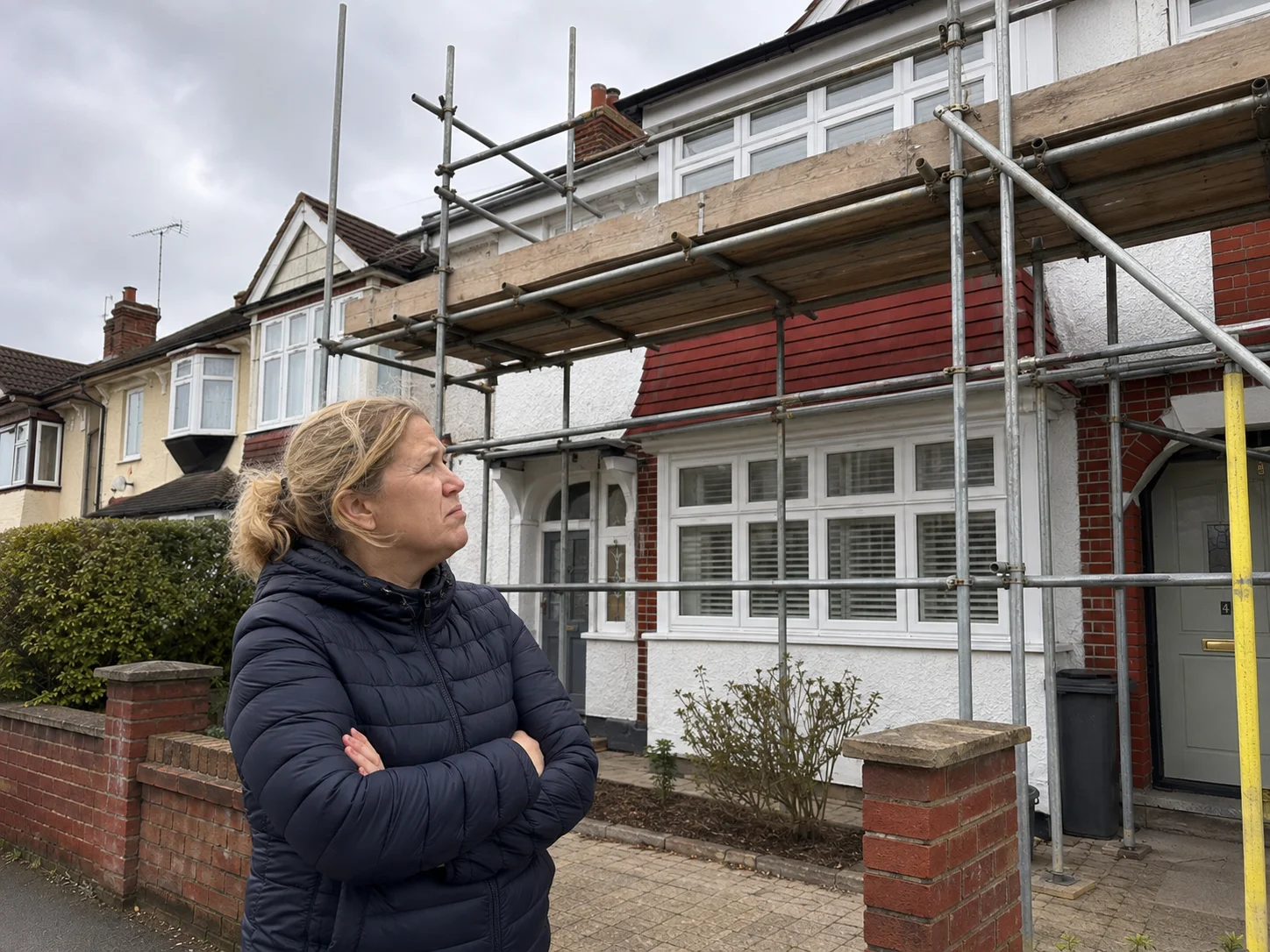
Terraced house with narrow frontage
Front scaffold needs part of the pavementThe inside standards sit within the house boundary, but the outside row of standards needs to stand on the public footway.
What if the scaffold goes over the pavement but doesn't touch it?
The requirement is not limited to scaffold standards physically sitting on paving slabs.
Section 169 refers to structures placed on or over the highway.
So a scaffold arrangement that projects over the public highway can still require highway authority approval even where the supporting standards themselves sit within private property.
Who applies for the scaffolding licence?
For a typical domestic job, the scaffolding contractor should deal with the application.
GOV.UK specifically states that it is the responsibility of the builder or scaffolding company to obtain the licence for scaffolding placed on the highway.
The homeowner or client nevertheless has an important responsibility: check that the licence exists and that it remains valid for the duration of the project.
Homeowners: don't accept “the council knows we're here” as proof of a licence. Ask the contractor to confirm the licence reference and authorised dates.
What information does a council usually ask for?
There is no single UK application form because applications are managed by individual highway authorities.
However, common requirements include:
How much public liability insurance is required?
This is another area where contractors should not assume every council has identical conditions.
Individual highway authorities set their own application requirements. Some currently require £5 million of public liability cover, while others require £10 million.
Manchester City Council, for example, currently requires evidence of public liability insurance of at least £10 million as part of a scaffolding permit application.
Bristol City Council currently specifies £5 million indemnity for its standard highway scaffold and hoarding licensing process.
For scaffolders: never hard-code one national insurance threshold into your estimating process. Check the conditions set by the actual highway authority for the job.
How much does a scaffolding licence cost?
There is no standard national licence price.
Councils set their own fees and charging structures. The fee can depend on:
- location;
- length of scaffold;
- area occupied;
- how long the scaffold remains;
- whether inspections are separately charged;
- whether a deposit is required;
- whether additional traffic management is needed; and
- whether the application is urgent or retrospective.
The difference between authorities can be substantial.
| Authority | Example requirement / charge | Notice / processing |
|---|---|---|
| Calderdale | £157 for up to 28 days at the time of checking. | Scaffolding company must apply at least 14 days before delivery. |
| Manchester | £175 administration charge plus inspection charges based on scaffold area and each four-week period. | Council states it will contact applicants within 20 working days. |
| Bristol | Standard scaffold licence currently starts at £90 for up to one calendar month. | Standard application at least 3 working days before erection; processing quoted as 3–10 days. |
| Southwark | Monthly charges vary by scaffold length, currently starting above £500. | Applications must currently be made at least 15 working days in advance. |
These are examples checked in August 2026 and should not be treated as a permanent price list. Always check the relevant authority before quoting because fees and conditions change.
Even neighbouring councils can operate differently
This is particularly important for scaffolding companies that cover several towns or cities.
Leeds City Council currently asks for a minimum of 10 working days for scaffolding and other relevant highway structures.
Calderdale currently states that the scaffolding company must apply at least 14 days before the scaffold is due to be delivered.
Manchester operates a different fee structure again and says an applicant will be contacted within 20 working days.
A scaffolder covering West Yorkshire and Greater Manchester therefore cannot sensibly operate from one generic:
“Scaffold permits take seven days and cost £100.”
That simply isn't how the system works.
A scaffold licence may not be the only permission you need
Getting the Section 169 scaffold licence does not automatically authorise every other obstruction or traffic-management measure required by the job.
Depending on the location and scaffold design, additional permissions can include:
- parking bay suspension;
- temporary footway closure;
- temporary road closure;
- temporary traffic restriction;
- hoarding licence;
- skip licence;
- crane or lifting-operation licence;
- MEWP or cherry-picker permit;
- oversailing permission; or
- other site-specific highway approvals.
For example, Calderdale explicitly requires an additional parking suspension where scaffold occupies a restricted parking bay.
Southwark notes that some jobs may require a Temporary Traffic Management Order in addition to the scaffold licence, and those orders can require substantially more advance notice.
What happens to pedestrians?
The licence does not simply give the contractor permission to block the pavement.
The highway authority will consider how pedestrians can safely pass the structure.
Depending on the site, this may involve:
- maintaining a clear pedestrian width;
- protective padding;
- lighting;
- warning signs;
- pedestrian barriers;
- covered walkways;
- temporary ramps;
- traffic management; or
- a formal footway closure.
HSE also says scaffold should not be erected or dismantled over people or busy pavements, and where the work presents danger to the public a footpath or road closure should be considered.
Can the scaffold go up while we're waiting for the licence?
Generally, no.
A submitted application is not the same thing as an issued licence.
Manchester, for example, explicitly states that contractors do not have permission to work on the highway until the licence has been received.
For programme planning: do not book an erection date assuming the council will have approved the application by then. Build the authority's processing period into the job programme.
What about emergency scaffolding?
Emergencies do not necessarily mean the licensing requirement simply disappears.
Some authorities provide emergency or short-notice procedures where scaffold is urgently required to protect people or property.
Bristol, for example, currently has a specific emergency scaffolding fee where an application is submitted fewer than three working days before erection.
If there is an immediate danger, contact the highway authority and, where appropriate, emergency services rather than assuming retrospective paperwork will automatically be acceptable.
What if the building work overruns?
Scaffold licences are normally issued for a defined period.
If the scaffold needs to remain on the highway beyond that period, the licence may need to be renewed or extended.
This matters because the building contractor may say:
“We only need another couple of weeks.”
From a highway licensing perspective, those extra two weeks can still require a valid extension.
GOV.UK specifically tells property owners to check that the licence does not expire before the building work is finished.
Does the council licence replace scaffold inspections?
No.
The highway licence and the scaffold inspection regime are different responsibilities.
Construction scaffolds still need to be inspected by a competent person:
- before first use;
- at intervals not exceeding seven days while in use; and
- after circumstances that could affect safety, including substantial alteration, damage or extreme weather.
Some highway authorities may also carry out their own inspections of licensed structures.
Scaffold licences shouldn't live in someone's inbox or diary reminder
Licence administration becomes difficult when a scaffolding company works across several authorities — each with different forms, fees, notice periods, insurance limits and renewal rules.
ScaffOps brings licence checks and licence requests into the actual job workflow.
Record the job location and whether scaffold affects a road, pavement, parking bay or other public highway.
Keep the relevant licence requirement and highway authority attached to the job rather than relying on memory.
Manage the licence request alongside the scaffold job and keep the application information and supporting documents together.
Record approval, reference, authorised dates, expiry and renewal status against the project.
Why licence tracking matters to scaffolding companies
Licensing is not only a compliance issue. It affects commercial and operational planning.
Consider a job booked for Monday morning:
- the gang is scheduled;
- the lorry is loaded;
- the roofer starts Tuesday;
- the scaffold requires pavement occupation;
- but nobody has confirmed the licence.
That problem can affect the scaffolder, roofer, homeowner and programme at the same time.
A licence workflow inside ScaffOps allows the permit status to become a genuine operational condition of the job:
Licence required → requested → approved → erection authorised.
That is considerably safer than:
“I'm sure Dave emailed the council.”
Should the licence fee be included in a scaffolding quote?
The quotation should make the position clear.
There is no reason a homeowner should discover after accepting the scaffold price that an additional council fee is being added without having been told that it may apply.
A clear scaffolding quotation might say:
Example wording
Highway scaffold licence: The proposed front scaffold requires occupation of the public footway. The applicable local authority scaffold licence will be arranged by us. The council's licence fee is [included in this quotation / charged at cost in addition].
Any additional parking suspension, footway closure or traffic management requirement identified by the authority will be advised separately before erection.
What should a homeowner check?
You do not need to become an expert in highway legislation.
Before scaffold affecting a pavement or road is erected, ask:
- Does this scaffold need a council licence?
- Who is applying for it?
- Is the licence fee included in my quotation?
- Has the licence actually been issued?
- What dates does it cover?
- Does the work require a parking or footway restriction?
- What happens if the job overruns?
- Who will extend the licence if necessary?
Need scaffolding for your property?
Enter your postcode and receive quotes from scaffolders who cover your area. Tell them about pavement or highway access when describing the job.
Scaffolding licence FAQs
Do I need a licence for scaffolding on my property?
If the scaffold is wholly on private property and does not encroach onto or over the public highway, a Section 169 highway scaffold licence will generally not be required. Other safety, planning or access requirements can still apply.
Do I need a licence for scaffolding on the pavement?
Yes. Scaffolding occupying or projecting over the public highway, including a pavement, normally requires a licence from the relevant highway authority.
Who applies for a scaffolding licence?
For normal building work, GOV.UK states that the builder or scaffolding contractor is responsible for obtaining the highway scaffold licence. Property owners should still check that the licence has been issued and remains valid.
How much is a scaffolding permit?
There is no single national price. Fees are set by the relevant highway authority and can depend on location, scaffold size, duration, inspections and additional highway requirements.
How long does a scaffolding licence take?
Processing times differ considerably between councils. Some request only a few working days' notice, while others currently request 10, 14, 15 or more working days. Always check the authority responsible for the actual site.
Can scaffolding be erected before the permit is approved?
Where a licence is required, the scaffold should not simply be erected because an application has been submitted. Wait until the appropriate highway authority has issued the required permission unless an authorised emergency procedure applies.
What happens if the scaffolding licence expires?
If the scaffold remains on the highway beyond the authorised period, the contractor may need to obtain an extension or renewal. Licence expiry should therefore be monitored alongside the actual scaffold hire period.
Do I need a separate permit for a parking bay?
Potentially. Some authorities require a separate parking suspension where scaffold occupies a controlled parking bay. The scaffold licence does not necessarily include every other permission needed for the site.
Does a scaffolding permit include inspections?
A highway licence does not replace the normal scaffold inspection regime. Construction scaffolds still require inspection by a competent person at the legally required intervals.
How does ScaffOps help with scaffold licences?
ScaffOps brings licence and permit management into the scaffold job workflow. Licence requirements, requests, supporting documents, authority references, approval status, authorised dates and renewals can be tracked against the relevant project rather than being managed through disconnected emails, spreadsheets and diary reminders.
GOV.UK — Scaffolding rules
GOV.UK — Find your local scaffolding and hoarding licence
HSE — Scaffold safety and highway licensing
Highways Act 1980 — Section 169
Council fees, requirements and processing times change. Always check the relevant highway authority before relying on a fee or timeframe shown in this article.